
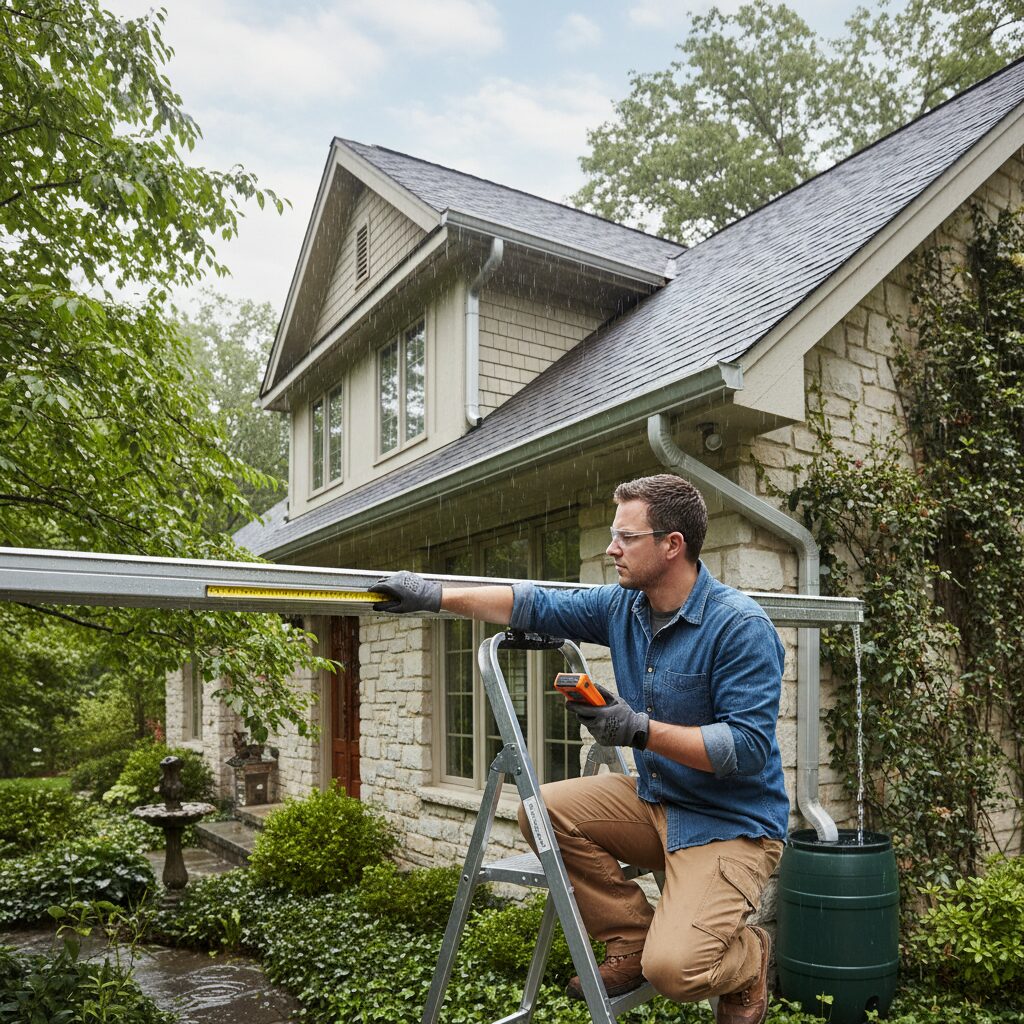
When a heavy storm rolls through, the last thing you want to worry about is whether your gutters can handle the deluge. Water is the single biggest enemy of your home’s foundation, siding, and landscaping. An undersized gutter system is like trying to drain a swimming pool with a drinking straw—it simply cannot keep up with the volume, leading to overflows that cause costly rot, mold, and basement flooding.
Many homeowners assume that standard gutters are a “one-size-fits-all” solution. In reality, the 5-inch gutters found on most homes are sufficient for many, but certainly not all, situations. Factors like steep roof pitches, complex rooflines, and intense local rainfall patterns can quickly overwhelm a standard system.
Whether you are planning a DIY upgrade or vetting professional quotes, understanding how to measure and size your gutters is critical. This guide will walk you through the mathematics and mechanics of gutter sizing, ensuring your home stays dry even during the heaviest downpours. And for those in the Garden State who prefer expert handling, Deluxe Construction is your Gutter Contractor In New Jersey, ready to ensure your system is perfectly calibrated to your home’s needs.
Understanding Your Gutter System
Before pulling out the tape measure, it helps to understand the components you are sizing. A rainwater drainage system isn’t just the horizontal troughs hanging off your eaves; it is a synchronized network designed to capture and redirect water flow.
The Gutter Profile
The “gutter” itself is the horizontal channel. The most common residential profile is the K-style gutter, which has a flat bottom and a decorative face that mimics crown molding. K-style gutters are incredibly efficient because they hold more water than their rounded counterparts.
The other primary option is the Half-Round gutter, which looks like a tube cut in half. These are often found on historic homes or chosen for their specific aesthetic appeal. While beautiful, half-round gutters generally have a lower water capacity than K-style gutters of the same width.
The Downspouts
Downspouts are the vertical pipes that carry water from the gutter to the ground. If your gutters are the highway, downspouts are the exit ramps. If the exits are blocked or too narrow, traffic jams (overflows) occur. Properly sizing your downspouts is just as important as sizing the gutters themselves.
Factors Influencing Gutter Size
Determining the right size involves more than just measuring the length of your roofline. You need to calculate the volume of water your roof sheds during a storm. This is influenced by three main variables:
- Roof Area: A larger surface area collects more water.
- Roof Pitch (Steepness): Steeper roofs shed water faster. Windblown rain also hits steep roofs with more intensity, effectively increasing the amount of water the gutter must catch.
- Rainfall Intensity: This is a geographic factor. A house in Seattle might get more rain days, but a house in New Jersey might experience more intense, short-burst thunderstorms that dump massive amounts of water in minutes.
Tools and Materials Needed
To get an accurate measurement, you will need to gather a few supplies. Safety is paramount—if you are not comfortable on a ladder, it is best to estimate from the ground or call a professional like Deluxe Construction.
- Heavy-duty tape measure (25 feet or longer)
- Extension ladder (sturdy and placed on solid ground)
- 2-foot level
- Calculator
- Pencil and notepad
- Safety gear (gloves and non-slip shoes)
Step 1: Calculating Your Roof Area
The first step in sizing your gutters is determining the square footage of the roof area that drains into each gutter run. You don’t necessarily need to climb on the roof to do this; you can often estimate it from the ground.
Measure the Footprint
Measure the length and width of the house section covered by the gutter. For a simple gable roof (two sides), you would measure the length of the gutter run and the distance from the eaves to the roof peak (the slope width).
Formula:
$$Area = Length \times Width$$
However, this only gives you the planar area. Because rain doesn’t always fall straight down—and because steep roofs catch wind-driven rain—you need to adjust this number based on the pitch of your roof.
Step 2: Determining the Roof Pitch Factor
The “pitch” is the slope of your roof, usually expressed as the number of inches the roof rises for every 12 inches of horizontal run (e.g., a 4/12 pitch means the roof rises 4 inches for every foot of width).
How to Find Roof Pitch
- Place one end of your 2-foot level against the roof surface.
- Adjust the level until the bubble is centered.
- Measure the distance between the roof and the bottom of the level at the 12-inch mark on the level.
- If the gap is 6 inches, you have a 6/12 pitch.
Once you have your pitch, use the Roof Pitch Factor table below to adjust your area calculation. This factor adds a buffer to account for the speed and volume of water shedding off steeper slopes.
Roof Pitch Factor Table:
- 12/12 pitch or higher: 1.3
- 9/12 to 11/12 pitch: 1.2
- 6/12 to 8/12 pitch: 1.1
- 4/12 to 5/12 pitch: 1.05
- Flat to 3/12 pitch: 1.0
The Adjusted Calculation
Multiply your initial roof area by the pitch factor to get your Total Adjusted Square Footage.
Example:
If your roof section is $40 \text{ feet long} \times 15 \text{ feet wide}$, your area is $600 \text{ sq. ft.}$
If the roof has a steep 10/12 pitch (Factor 1.2), your calculation is:
$$600 \times 1.2 = 720 \text{ Adjusted Square Feet.}$$
Step 3: Determining Rainfall Intensity
Rainfall intensity is measured by the maximum inches of rain that can fall in a 5-minute interval. This “flash flood” potential is what causes gutters to overflow.
According to data sources like the NOAA Atlas 14, different regions have different maximum intensity ratings. For standard sizing purposes, you can check the U.S. Weather Bureau records for your specific city.
However, a safe standard used by many contractors in areas with heavy seasonal storms (like New Jersey) is to plan for a high-intensity event. If you are unsure, consulting with a local expert like Deluxe Construction can provide the exact rainfall intensity data for your specific county.
Step 4: Calculating Gutter Capacity
Now that you have your Adjusted Square Footage, you can match it against the capacity of standard gutter sizes. The goal is to ensure the gutter is large enough to handle the drainage area without spilling over.
Here are the maximum drainage capacities for the most common gutter sizes (assuming K-style gutters, which are standard for most modern homes):
K-Style Gutter Capacities
- 5-Inch K-Style Gutter: Can handle approximately 5,520 square feet of roof area.
- 6-Inch K-Style Gutter: Can handle approximately 7,960 square feet of roof area.
Half-Round Gutter Capacities
If you prefer the look of half-round gutters, be aware they hold less water:
- 5-Inch Half-Round: Can handle approximately 2,500 square feet.
- 6-Inch Half-Round: Can handle approximately 3,840 square feet.
Step 5: Choosing the Right Gutter Size
Comparing your math from Step 2 to the capacities in Step 4 will reveal your answer.
Scenario A: Your adjusted roof area is 1,200 square feet.
- Verdict: A standard 5-inch K-style gutter (capacity 5,520 sq. ft.) is more than sufficient. This is why 5-inch gutters are the residential standard—they cover the needs of most average-sized homes.
Scenario B: You have a massive, steep roof section measuring 6,000 adjusted square feet draining into a single gutter run.
- Verdict: A 5-inch gutter would likely overflow. You need to upgrade to a 6-inch K-style gutter (capacity 7,960 sq. ft.) to handle the volume safely.
Why Go Bigger?
Even if your math says a 5-inch gutter is technically enough, many homeowners and contractors are upgrading to 6-inch gutters (“oversized gutters”). The 6-inch option minimizes clogging because the outlet is larger, and it offers a better safety margin during those “once-in-a-century” storms that seem to happen every year now.
Step 6: Don’t Forget the Downspouts
Gutters are useless if the water has nowhere to go. You generally need one downspout for every 30 to 40 feet of guttering.
Just like the gutters, downspouts come in different sizes:
- 2×3-inch Downspouts: These are paired with 5-inch gutters. They can handle roughly 600 square feet of drainage per downspout.
- 3×4-inch Downspouts: Usually paired with 6-inch gutters (or added to 5-inch gutters for better flow). These can handle roughly 1,200 square feet of drainage.
If your capacity calculations are borderline, increasing the size of your downspouts to 3×4 inches is a cost-effective way to boost the system’s performance without replacing the entire gutter run.
Common Mistakes to Avoid
Even with the right math, installation errors can ruin the system’s efficiency.
- Ignoring Roof Valleys: A valley is where two roof slopes meet, concentrating water into a powerful stream. The gutter section beneath a valley has to handle water from both slopes. It often requires splash guards and higher capacity sizing.
- Guessing the Pitch: Underestimating the steepness of your roof is the most common calculation error. A steep roof shoots water into the gutter at high velocity; if the gutter is too small or hung too low, the water will overshoot the edge entirely.
- Too Few Downspouts: Aesthetic concerns often lead homeowners to minimize downspouts. This causes water to back up, leading to standing water in the gutters, which breeds mosquitoes and causes rust.
Professional vs. DIY: Making the Call
Can you install gutters yourself? Technically, yes. Home improvement stores sell sectional gutters (vinyl or aluminum) that you can piece together. However, DIY gutters come with significant downsides.
The Seam Problem
DIY gutters are sold in sections that must be sealed together. Every seam is a potential leak point and a catch point for debris. Professional contractors, like Deluxe Construction, install seamless gutters. These are custom-fabricated on-site from a single continuous coil of aluminum, customized to the exact length of your home. They have no seams (except at corners), reducing leak risks to near zero.
Safety and Precision
Hanging gutters requires working on a ladder while handling long, unwieldy pieces of metal. Getting the “slope” right—typically ¼ inch of drop for every 10 feet of run—is difficult for a novice but essential for drainage. If the gutter is hung flat, water sits stagnant. If it’s pitched too steeply, it looks crooked and unattractive.
For homeowners in New Jersey, relying on a professional contractor ensures the job meets local building codes and stands up to the region’s specific weather challenges.
Maintenance Tips to Protect Your Investment
Once your properly sized gutters are installed, maintenance is key to longevity.
- Clean Twice a Year: At a minimum, clean gutters in spring (after seeds fall) and late autumn (after leaves fall).
- Install Gutter Guards: If you have pine trees or heavy foliage, high-quality gutter guards can prevent clogging and reduce maintenance frequency.
- Check for Sagging: Heavy snow and ice can pull gutters loose. Inspect spikes and hangers annually to ensure they are tight against the fascia board.
Conclusion: Protect Your Home with Precision
Measuring gutter size is a science that combines geometry with meteorology. While the standard 5-inch gutter works for many, taking the time to calculate your roof area, pitch, and rainfall intensity ensures you aren’t leaving your home vulnerable to water damage.
If the math feels overwhelming, or you simply want the peace of mind that comes with professional installation, help is available. Deluxe Construction is your Gutter Contractor In New Jersey, offering expert assessments, seamless installation, and a commitment to keeping your home dry and beautiful. Don’t wait for the next storm to reveal the flaws in your system—measure, plan, and upgrade today.